Thursday, May 9, 2013

Comment Period Reopened for Proposed Listing of the Spring Pygmy Sunfish as Threatened

The U.S. Fish & Wildlife Service (USFWS) has reopened the public comment period on the proposal to list the Spring Pygmy Sunfish (Elassoma alabamae) as threatened with critical habitat designated. (http://www.gpo.gov/fdsys/pkg/FR-2013-04-29/pdf/2013-09974.pdf). Public comments were reopened primarily due to 1) a slight reduction in proposed critical habitat (private property was inadvertently included in first proposal) and 2) a draft economic analysis is now available for review.

The Spring Pygmy Sunfish (Elassoma alabamae). Photo by Bernie Kuhajda.
Spring Pygmy Sunfish are restricted to springs and spring-fed creeks along a five-mile length of Beaverdam Creek in northern Alabama near Huntsville. This species was historically known from two other spring systems in the Tennessee River drainage in Alabama, but habitat destruction from dams, reservoirs, and herbicides caused these populations to disappear. It only reaches 1 inch, lives for a year, and needs clear spring water and dense submerged vegetation.  Spring Pygmy Sunfish are reliant on their vision to find food and mates, so clear water is essential.  The dense submerged vegetation is needed for the eggs to be successfully laid, hatched, and for juveniles and adults to hide from predators. These life history traits make the species vulnerable to habitat disturbances that muddy the water, herbicides that reduce or kill aquatic vegetation, and groundwater withdrawals. Lower water levels, together with drought conditions, have caused springs in the system to go completely dry.

Beaverdam Spring, ideal habitat for the Spring Pygmy Sunfish. Photo by Bernie Kuhajda.
Spring Pygmy Sunfish habitat in the Beaverdam Creek system is highly imperiled due to the rapid growth of nearby Huntsville (http://www.sasaki.com/project/227/huntsville-western-expansion-annexed-property-master-plan/) and an increase in agricultural and municipal groundwater pumping in the aquifer that feeds these springs. Construction projects with no or improperly installed silt fences and an increase in impervious surfaces that produces heavy stormwater runoff threaten water quality.

Ineffective silt fences along Beaverdam Creek that contribute to the siltation of critical habitat for the Spring Pygmy Sunfish. Photo by Mike Sandel.
Impervious surfaces also threaten water quantity by deflecting water that would normally recharge the underlying aquifer. These are just some of the escalating threats that Beaverdam Creek and the Spring Pygmy Sunfish are facing.

USFWS had determined that listing the Spring Pygmy Sunfish as threatened rather than endangered is warranted primarily due to conservation measures in a candidate conservation agreement with assurances (CCAA) between USFWS and Belle Mina Farm, Ltd. This company owns Beaverdam Spring, by far the largest spring in the system. However this CCAA gives no protection to the majority of the critical habitat and can be terminated at any moment. The Spring Pygmy Sunfish is restricted to one creek system, is totally reliant on groundwater, and there is an imminent threat of urbanization/industrialization within the recharge area of the aquifer. This led the Southeastern Fishes Council to consider the Spring Pygmy Sunfish as one of the Desperate Dozen, one of the 12 most critically imperiled fish species in the southeast (http://www.sefishescouncil.org/proceedings/sfcpro51.pdf). I personally think the Spring Pygmy Sunfish should be listed as endangered based on the best available science.

Tuesday, May 7, 2013

Pallid Sturgeon Draft Recovery Plan Available

The U.S. Fish and Wildlife Service has released a draft revised recovery plan for the endangered Pallid Sturgeon Scaphirhynchus albus (http://ecos.fws.gov/docs/recovery_plan/Pallid%20Sturgeon%20Draft%20Revised%20Recovery%20final%20draft%2003%2004%202013%20for%20web%20publication.pdf). The species was listed as endangered in 1990, with the original recovery plan finalized in 1993. The Pallid Sturgeon is native to the Missouri and Mississippi rivers where it is restricted to the mainstem and lower reaches of larger tributaries.


The Pallid Sturgeon Scaphirhynchus albus. Illustration by Joe Tomelleri.
This species is adapted to the pre-development conditions of free-flowing turbid warm water rivers with a variety of physical habitats that were in a constant state of change. Pallid Sturgeon reach 5.5 feet and 90 pounds and can live up to 41 years, with largest and oldest individuals being found in the upper Missouri River and smaller sizes in the lower Mississippi River. Males are not sexually mature until age 5 or later and females may not reproduce until age 15-20 years. They migrate upstream in the winter, spawning in the spring on hard surfaces with flowing water. Females can produce up to 170,000 eggs, but an individual female only spawns every 3-10 years; males spawn every 2-3 years. Upon hatching, larvae are photopositive (attracted to light) and drift in the water column for 11-17 days and 152-329 miles. Reservoirs below spawning grounds can result in total recruitment failure likely due to larvae settling to the bottom and dying. Pallid Sturgeon cruise along the river bottom to locate and eat invertebrates and small fishes with the aid of taste buds on their barbels and ampullary organs on the underside of their head, which use electroreception to detect the weak electrical fields emitted by prey.

Two adult Pallid Sturgeon from different parts of their range, the larger specimen is from the upper Missouri River and the smaller southern specimen is from the lower Mississippi/Atchafalaya Rivers. Photo by Bernie Kuhajda.

Current limiting factors for Pallid Sturgeon include (1) activities that affect connectivity and the natural form, function, and hydrologic processes of rivers; (2) illegal harvest, especially females for their eggs for caviar production; (3) impaired water quality and quantity; (4) entrainment in water diversion structures such as flood gates; and (5) life history attributes of the species (delayed sexual maturity, females not spawning every year, and larval drift requirements). The degree to which these factors affect the species varies among river reaches. The draft revised recovery plan focuses on a number of key issues: 
  • The need to better understand certain life history traits and the complex interactions between these traits and altered habitats in the contemporary Missouri and Mississippi River basins.
  • Threats abatement
    • The listing of the Shovelnose Sturgeon (S. platorynchus) as threatened due to similarity of appearance within the range of the Pallid Sturgeon should decrease illegal harvest by eliminating caviar harvest.
  • Population management using augmentation to conserve extant genetic variability and prevent localized extirpation.
  • Researching and implementing habitat improvement.
  • Monitoring habitat conditions.
  • Monitoring population status.

Map of current range of Pallid Sturgeon, both wild and hatchery-reared fish. Data by National Pallid Sturgeon Database, U.S. Fish and Wildlife Service, Bismarck, North Dakota. Figure from the draft revised recovery plan.

USFWS requests your assistance by reviewing the draft revised recovery plan and providing any information that you may have on the Pallid Sturgeon that is not already included.  Information must be submitted on or before 14 May 2013 and can be submitted to the Project Leader, Northern Rockies Fish and Wildlife Conservation Office, U.S. Fish and Wildlife Service, 2900 4th Avenue North, Room 301, Billings, MT 59101.

Thursday, April 18, 2013

New Darter Species from Tennessee’s Caney Fork River


A new species of fish only found in the state of Tennessee was scientifically described this month and was named after a co-author of The Fishes of Tennessee book. The new species was formerly considered an isolated population of the Bloodfin Darter Etheostoma (Nothonotus) sanguifluum, which is otherwise widespread in medium-sized creeks throughout the middle Cumberland River drainage in Kentucky and Tennessee.

The Bloodfin Darter, Etheostoma sanguifluum (or Nothonotus sanguifluus, see below) from the middle Cumberland River drainage in Kentucky and Tennessee. C) male and D) female. From figure 3 in Keck and Near 2013.
 
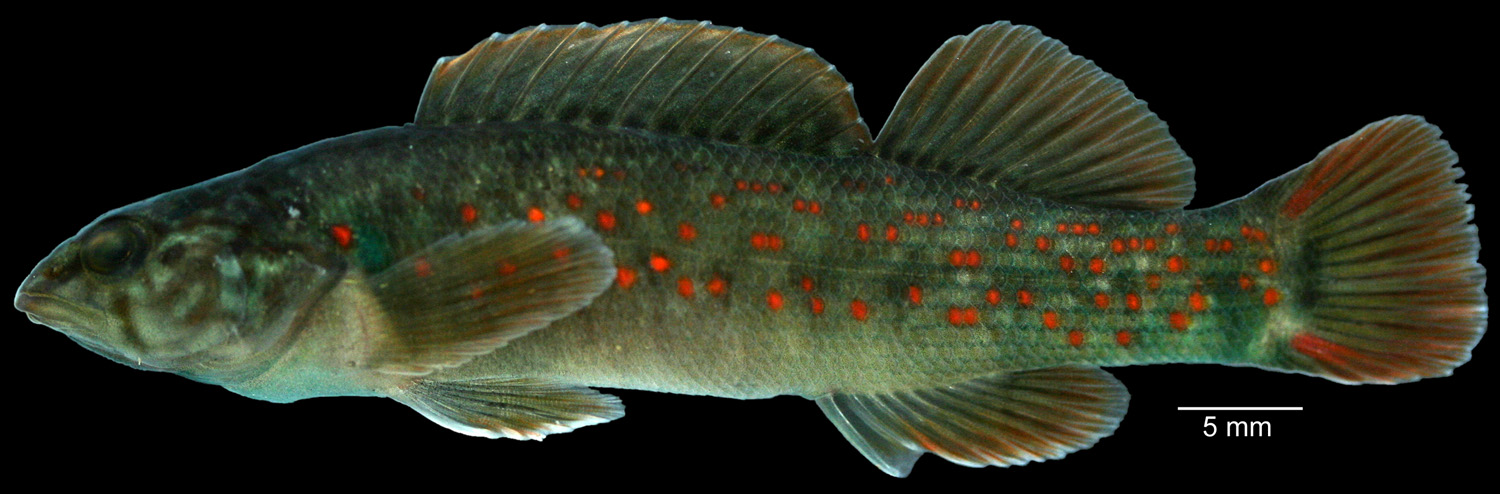
Ben Keck at the University of Tennessee and Tom Near at Yale University described the new species based on differences in male nuptial coloration and scale counts.  The new species is the Caney Fork Darter Nothonotus starnesi, restricted to the Caney Fork River system above Great Falls in Grundy, Van Buren, Warren, and White counties near McMinnville Tennessee. It is named after Wayne Starnes, co-author of the Fishes of Tennessee and Curator of Fishes at the North Carolina Museum of Natural History, for his contributions on the natural history and biology of North American freshwater fishes.
 
The Caney Fork Darter, Nothonotus starnesi, from the Caney Fork River system above Great Falls near McMinnville Tennessee Photo of nuptial male by Dave Neely.

The Caney Fork Darter, like many other darters, displays sexual dimorphism which is most pronounced during the breeding season (May-July), with males having bright red spots on their sides and red and blue in their fins. The species occupies fast-flowing riffles over large cobble and small boulders in medium to large streams. Most populations appear stable, but the Caney Fork Darter’s restricted range, impoundment of habitat by the Great Falls reservoir, and threats from intensive silviculture, livestock production, urbanization, and invasive species put this species at risk and may require future conservation efforts.
The Caney Fork Darter, Nothonotus starnesi, from the Caney Fork River system above Great Falls near McMinnville Tennessee E) male and F) female. From figure 3 in Keck and Near 2013


The taxonomy of the scientific names of the Bloodfin and Caney Fork darters and their close relatives is undergoing changes. These species, as well as some twenty other species, were previously placed in the subgenus Nothonotus within the genus Etheostoma (Etnier and Starnes 1993). Molecular studies based on a mitochondrial gene indicated that the subgenus was more closely related to other darter genera, leading Near and Keck (2005) to elevate Nothonotus to the generic level, which changed the ending on the specific epithet of many species to match the gender of the new genus (e.g. sanguifluum to sanguifluus).  Later molecular studies using nuclear genes in combination with mitochondrial genes (Near et al. 2011) or nuclear genes alone (Near and Keck 2013) showed that Nothonotus and Etheostoma are sister taxa, therefore some ichthyologists retain the genus Etheostoma for these darters while others recognize Nothonotus as a distinct genus.
Distribution of the Caney Fork Darter, Nothonotus starnesi, and other closely-related species in the Cumberland River drainage in Kentucky and Tennessee From figure 2 in Keck and Near 2013.
Citation for species description:
Keck, B.P., and T.J. Near. 2013. A new species of Nothonotus darter (Teleostei: Percidae) from the Caney Fork in Tennessee, USA. Bulletin of the Peabody Museum of Natural History 54:3-21.
 
Other citations:
Etnier, D.A., and W.C. Starnes. 1993. The Fishes of Tennessee. The University of Tennessee Press, Knoxville.
 
Near, T.J., C.M. Bossu, G.S. Bradburd, R.L. Carlson, R.C. Harrington, P.R. Hollingsworth Jr., B.P. Keck, and D.A. Etnier. 2011. Phylogeny and temporal diversification of darters (Percidae: Etheostomatinae). Systematic Biology 60:565-595.
 
Near, T.J., and B.P. Keck. 2013. Free from mitochondrial DNA: nuclear genes and the inference of species trees among closely related darter lineages (Teleostei: Percidae: Etheostomatinae). Molecular Phylogenetics and Evolution 66:868-876.
 
Near, T.J., and B.P. Keck. 2005. Dispersal, vicariance, and timing of diversification in Nothonotus darters. Molecular Ecology 14: 3485-3496.

Wednesday, March 27, 2013

Study Predicts Climate Change Threatens Trout Habitat

A study by researchers from the U.S. Forest Service, the U.S. Geological Survey, Colorado State University, the University of Washington and Trout Unlimited found that climate change will likely cause a 50% decrease in trout habitat by 2080 in the western United States. Warmer temperatures as well as changes in stream flow and interactions with competing species were all named as contributors to the decline.

The Cutthroat Trout (Oncorhynchus clarkii), the only trout species native to much of the West, is projected to be the most drastically impacted. The Westslope Cutthroat Trout (Oncorhynchus clarkii lewisi), a subspecies, is the Montana state fish and has inspired numerous conservation efforts.

Cutthroat Trout (Oncorhynchus clarkii)

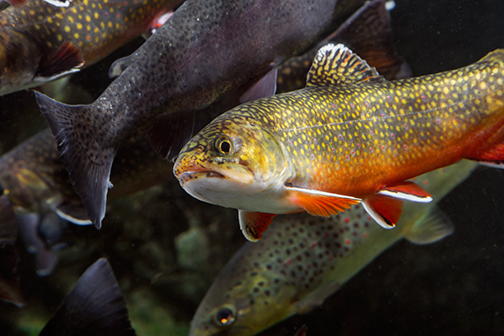
TNACI scientists share a similar focus on the Southern Appalachian Brook Trout (Salvelinus fontinalis) – the only trout species native to Tennessee. Last October, TNACI began a propagation study of the Brook Trout, funded by a grant from the National Fish & Wildlife Federation. Adult brood stock were collected from Hampton Cove Creek and brought back to TNACI where gametes were stripped and eggs were fertilized. The baby brook trout that hatched from the eggs are currently growing strong and will be released in August back into the river from which their parents were caught. This species is sensitive to increasing water temperatures and has a maximum temperature tolerance of 55 degrees Fahrenheit.

Brook Trout (Salvelinus fontinalis)
 
Reviewers of the climate change study note that Montana’s high elevation and northern positioning may help to buffer some of the effects that may be magnified in other regions. This is particularly significant to TNACI’s work which focuses on conserving freshwater habitats in the Southeast - which may not experience this buffering when it comes to climate change. 


Sunday, February 3, 2013

Fish Bowl Sunday!


One of the reasons we work in the southeastern United States is because of the amazing aquatic biodiversity here—lots of crayfish, mussels, fish, turtles, and salamanders to study!  For many nature nuts like us, this web of life is awesome simply because it exists.  Sometimes we give other reasons on why biodiversity matters, though.  This weekend, we have the perfect chance for one of our favorite analogies.

Biodiversity matters because the Big Game on Sunday would be pretty boring if all the players on the field were in the same position.  Who would want to watch a bunch of quarterbacks throw balls when no one was there to catch them?  What’s the fun of a touchdown when you didn’t have to race past the cornerback and safety?  And what’s the point of a pass rush when there is no one passing?  Our rivers are just the same—we need a lot of different fishes swimming around to keep things interesting!

Because we are fish AND sports nerds, we decided to create our fantasy Fish Bowl Sunday for you… so without further ado, here are the starting line-ups!  Representing the American Fishes Conference is Benthic Bait, playing the Fantastic Fins from the National Fishes Conference.  The Benthic Bait are coached by the Prickly Sculpin, while the Fantastic Fins are led by the Redface Topminnow.

Prickly Sculpin
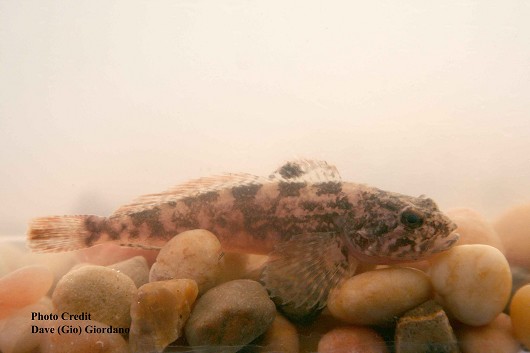
The game starts with the Spangled Darter singing the national anthem.  Officiating for this game are our refs, a Striped Bass, Banded Pygmy Sunfish, Striped Shiner, and Striped Mullet.  A Chainback Darter and a Chain Pickerel will be keeping track of the first down markers. 

Chainback Darter.  Photo by Todd Crail.
For the Benthic Bait, a Flier kicks off with the Fantastic Fins receiving.  The offensive line for the Fantastic Fins is made up of Shield and Guardian Darters, protecting their quarterback, the Pretty Shiner.  Split wide and blazing down the field are Flame Chubs as wide receivers.  The Southern Studfish receives short passes as the tight end.  When it’s time for the running game, an American Eel slips through the gaps being cleared for him by the Yellow Bullhead.  They’re hoping not to have to use their field goal kicker, the Crown Darter, who only really earns his name if he makes that last-second game-winning kick.

American Eels.
On the defense for the Benthic Bait we have the Robust Redhorse in the middle of the line, flanked by two Bull Trout.  Pressuring the Pretty Shiner are the Rush Darters, eager to make a sack.  Following every move of the Flame Chubs are the cornerbacks, the Mirror Shiners.  Ready to stop the run or pass are the linebackers, Dirty and Warrior Darters, with our safeties, the Bigeye and Slender Chubs.  Due to injuries from this season, the Wounded Darter, Cutlip Minnow, and Bleeding Shiner will be sitting this game out.

Bleeding Shiner.  Photo by Lance Merry.
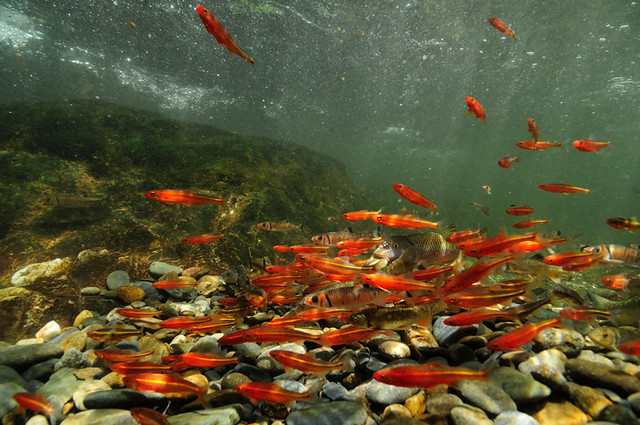
Of course, no football game is complete without an audience (who had to pay a lot of Dollar Sunfishes to get in).  The stands are packed with fins—oops, we mean fans!  We see a lot of Fantail Darters out there, as well as some really enthusiastic supporters who came out in color...  Tennessee Shiners, Saffron Shiners, and Warpaint Shiners.

Spring in Tennessee!  Photo by Lance Merry.
Hopefully, unlike a lot of championship games, this one will be close to the end, keeping those fans sitting on Pinfish and Needlefish!


Post co-authored by Bernie Kuhajda and Anna George.

Tuesday, December 11, 2012

Happy Darter Holidays from TNACI

T’was time for the holidays in the state of Tennessee
And everyone at TNACI was happy as can be.
We’re ready for some fun, some food, and maybe snow
And to feature some fishes we love and we know.

If you tend to celebrate the Christian way
And have your winter holiday on Christmas Day,
Then maybe you’ll find a new friend and ally
In a very special fish, Etheostoma hopkinsi.

Christmas Darter (E. hopkinsi) photo by Dustin Smith

And if Santa visits your house, tell your kids to be good
Cuz they’ll want some sweets, that’s well understood.
So show them an image of some aquatic fun
With E. osburni and E. neopterum.

Candy Darter (E. osburni) Photo by Cory Dunn 
Lollipop Darter (E. neopturum) illustration by Joe Tomelleri

But if you’ve been bad, you know what will be
In your stocking that day or under the tree.
There’ll be no sweets, no presents, nada,
Except maybe E. cinereum or Percina brevicauda.

Ashy Darter (E. cinereum) illustration by Joe Tomelleri.
Coal Darter (Percina brevicauda) illustration by Joe Tomelleri.

We hope that you laughed due to this little ditty.
I really can’t lie, fish humor makes us giddy.
Instead of singing carols to you, with flutes and a drum,
We will just say have a Happy Etheostoma brevirostrum.


Holiday Darter (E. brevirostrum) illustration by Joe Tomelleri.


Friday, December 7, 2012

What are 303(d) Streams?


Freshwater is the most important resource on this planet.  Without it, humans cannot live.  However, with development and industrialization has come the pollution of freshwater bodies on which we rely.  During the 20th century, the USA reached a breaking point with its water bodies.  Estimates state that about  65% of streams were polluted, but no one knew for sure.  Some rivers so polluted from industry and development that they caught fire


http://www.ohiohistorycentral.org/images/11-3-52.jpg 
To bring water pollution under control, Congress passed the Clean Water Act (CWA) in 1972.  This October was the 40th Anniversary of its passing!  Under this act the EPA must regulate how much pollution industries discharge into rivers.  Under Section 303(d) of the Clean Water Act, states must compile a list of water bodies that exceed federal limits of pollutants.  Any stream on this list is called a 303(d) stream.  Prior to the passing of the CWA, there was no way for the public to know how many water bodies were impaired in their communities or which streams were unsafe.  Now, agencies must monitor pollutants in rivers and update the list of 303(d) streams every few years. Once a stream or river is on this list, it is considered a priority for water quality improvement.  This can be accomplished by strict permitting and enforcement on industry, or preventative efforts to reduce runoff.

In Tennessee, the Tennessee Department of Environment and Conservation (TDEC) is the agency that is responsible for listing 303(d) streams.  For an updated list of impaired streams in Tennessee, click the link below.  Here in Hamilton County there are about 30 impaired streams covering approximately 200 miles.